
What’s causing our declining fertility?
Fertility is one of the clearest indicators of overall health. When a species can't reproduce properly, something has gone fundamentally wrong.
And that’s where we are right now.
The numbers don't lie
Infertility now affects roughly 1 in 6 people globally—nearly double the estimates from just a decade ago.
The trend isn't slowing down either — a 2025 study analysing 204 countries found that infertility prevalence has been rising by roughly 0.5–0.7% per year since 1990, and is projected to continue climbing.
In men, sperm counts have declined by roughly 50% over the past five decades. Testosterone levels have been declining across generations — independent of age and obesity — a pattern now confirmed across multiple countries and shows no signs of reversing. In women, conditions like PCOS — which now affects an estimated 66 million women globally — are another growing reproductive concern.
Even when conception succeeds, the road is far from smooth. An estimated 23 million miscarriages occur every year globally— that’s 44 pregnancy losses every minute, roughly 15% of all pregnancies. One in ten women will experience at least one miscarriage. The Lancet's landmark series on miscarriage identified alcohol, air pollution, pesticide exposure, stress, and night-shift work among the confirmed risk factors—all hallmarks of modern life.
Caesarean sections now account for over 20% of births globally. C-sections are now considered routine, but babies born this way miss out on colonisation by the mother's vaginal microbiome—a process that appears critical for setting up the newborn's immune system—and the long-term consequences, including links to immunological diseases, are only now being understood.
The IVF industry tells the story
IVF has helped many people become parents. That’s a great thing.
But the fact that it’’s becoming increasingly necessary? That’s not so great.
In the United States, over 100,000 IVF babies were born in 2024—1 in every 36 births. The global IVF market is now valued at roughly $26 billion, projected to nearly triple by 2034.
That's not a sign of progress. That's an industry built on the back of a population that is losing its ability to reproduce without medical intervention.
IVF is not particularly effective. Success rates vary dramatically — under 35 years, roughly 1 in 3 cycles results in a live birth.
IVF is also very expensive, physically demanding, and emotionally draining. And it does nothing to address why people are struggling to conceive in the first place.
We're spending billions to work around a problem that didn’t previously exist—that we should be trying to prevent, not manage.
What's driving the decline
It's not one thing. It's a convergence of modern factors that our physiology was never designed to handle.
We stopped eating the nutrients that promote reproductive health
Cholesterol is the sole precursor to every steroid hormone in the body—pregnenolone, testosterone, progesterone, Vitamin D, estrogen, cortisol, all of them. The biosynthesis pathway runs: cholesterol → pregnenolone (and from there to the rest of the steroid family).
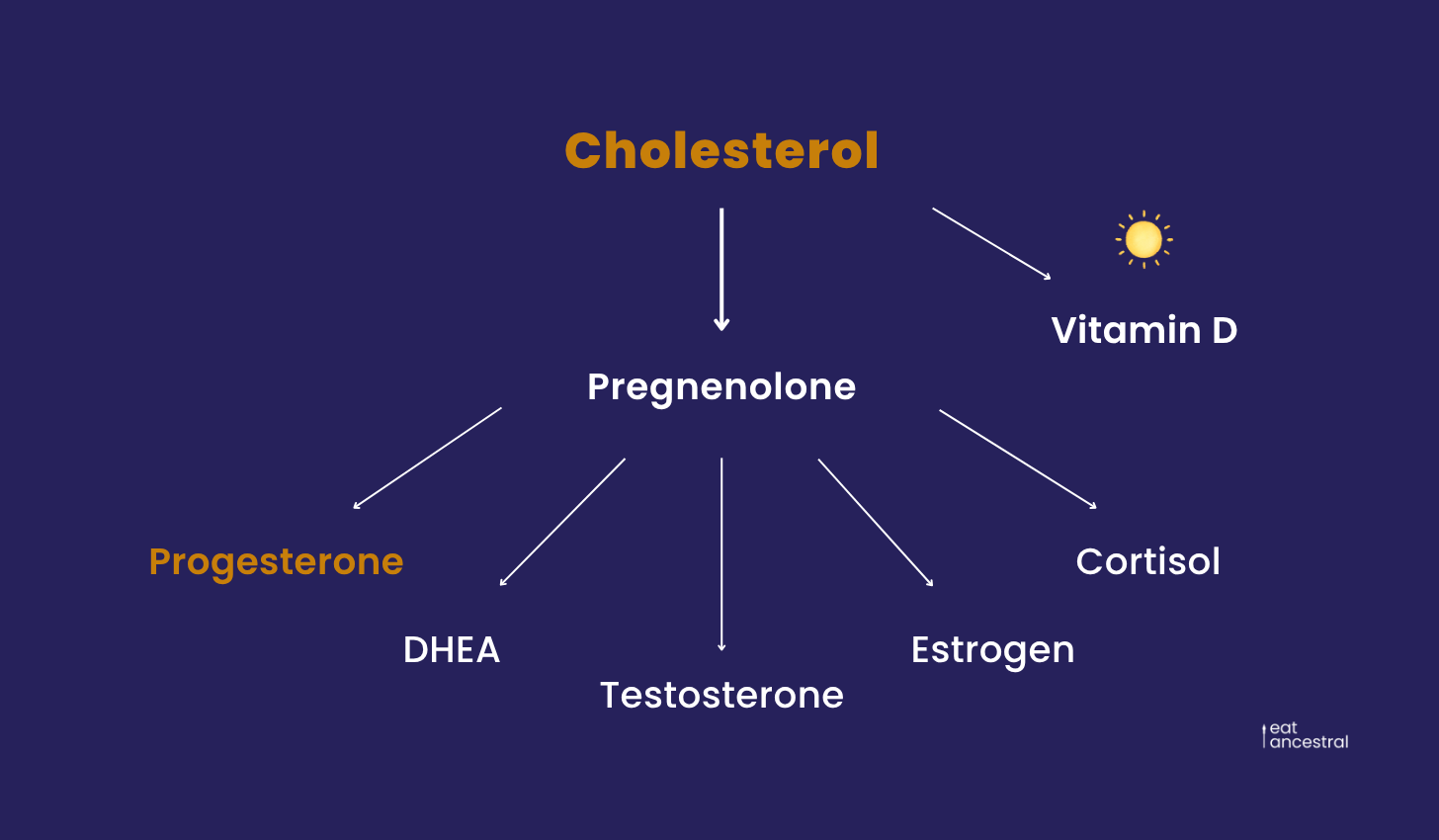
In women, progesterone orchestrates the entire reproductive process. It triggers ovulation, prepares the uterus for implantation, sustains the placenta, and supports the development of the baby's brain, nervous system, and organs. Beyond reproduction, progesterone is the body's most protective hormone — anti-inflammatory, anti-stress, and essential for energy production at the cellular level. Without adequate cholesterol, the body cannot make enough of it. In men, low-fat diets are associated with reduced testosterone. The consequences for women's reproductive hormones—particularly progesterone—follow the same biochemical logic.
Cholesterol isn't the only thing missing. The fat-soluble vitamins — A, D, E, and K — are essential cofactors in reproductive health, and they work synergistically. Vitamin E was named tocopherol, from the Greek — tókos meaning 'childbirth' and phérein meaning 'to carry' due to its critical role in reproduction. Vitamin A is critical for placental development and gene expression. Add zinc, selenium, iodine, magnesium, and calcium to the list, and the picture becomes clear: modern diets are deficient in many of the nutrients required for optimal reproductive function.
For decades, mainstream dietary advice has demonised cholesterol, saturated fat and red meat without good reason. We are paying a heavy price.
We are swimming in estrogen
Estrogen is not the fertility hormone. Progesterone is.
Progesterone and estrogen are antagonistic — they oppose each other. When progesterone is adequate, it keeps estrogen in check. When progesterone drops, estrogen becomes dominant. This balance is fundamental to fertility, and in the modern world, it's weighted far too heavily towards estrogen.
Ray Peat documented extensively that cancer, abnormal blood clotting, and infertility were known to be caused by excess estrogen as early as the 1930s — yet the pharmaceutical industry rebranded it as "the female hormone" and marketed it as pro-fertility. Unchecked, estrogen promotes inflammation, histamine release, water retention, and mimics the stress response at a cellular level. It is a shock hormone, a growth and proliferation signal, not a fertility hormone.
Progesterone is the counterbalance — and when it becomes deficient after implantation, miscarriage occurs. It is that direct.
Dr. Katharina Dalton — the British physician who coined the term "premenstrual syndrome" in 1953 — demonstrated this clinically for over 40 years. As a pregnant medical student, she noticed her lifelong monthly migraines had disappeared. The reason was simple: during pregnancy, progesterone production soars. She went on to show that PMS — the bloating, migraines, anxiety, depression, irritability, and water retention that millions of women experience every month — is fundamentally a progesterone deficiency relative to estrogen. She treated it successfully with natural progesterone for decades, and identified that postnatal depression follows the same pattern — a sharp decline in progesterone after birth.
The modern environment pushes this balance in the wrong direction from both sides. Xenoestrogens from plastics, estrogenic pesticides, and phytoestrogens from soy all drive estrogen up. Meanwhile, chronic stress also depletes progesterone directly — during times of stress the body diverts pregnenolone toward cortisol production, prioritising survival over reproduction. Combine that with the nutrient deficiencies discussed above, and you have a population that is estrogen-dominant, progesterone-depleted, and struggling to conceive.
Our metabolic rate is slowing down
Here is another fact that doesn't get enough attention: human body temperature has been declining for over 150 years.
Body temperature is a reliable indicator of metabolic rate. A declining population-wide temperature suggests a declining population-wide metabolism. And metabolism governs everything—energy production, hormone synthesis, immune function, and yes, fertility. A body that can't produce adequate heat is a body that is under-producing energy at the cellular level.
This aligns with what is seen clinically—cold hands and feet, sluggish thyroid function, excess body fat, difficulty conceiving—are all symptoms of a suppressed metabolic rate. The modern cocktail of seed oils, nutrient deficiencies, chronic stress, and endocrine-disrupting chemicals is slowing us down from the inside.
We're poisoning ourselves
The modern environment is loaded with compounds that human physiology never encountered until very recently.
Environmental pollutants are consistently linked to declining sperm quality. Plastics contain xenoestrogens that disrupt sex hormone balance. Non-stick cookware leaches PFAS — 'forever chemicals' — into our food. Estrogenic pesticides and mycotoxins contaminate the food supply.
We are exposed to thousands of synthetic compounds that didn't exist a century ago, and we have very little understanding of how they interact inside the human body.
Over the past fifty years, the composition of human body fat has fundamentally changed. Linoleic acid—an omega-6 fatty acid found in industrial seed oils—has increased by 136% in human adipose tissue, directly correlated with the rise of soybean, canola, and sunflower oil in the food supply.
We are literally made of different fat than our great-great-grandparents were.
Due to their chemical structure, these fats oxidise easily, producing toxic compounds that drive chronic inflammation — partly by fuelling the production of prostaglandins. They also suppress the metabolic rate. Our ancestral omega-6 to omega-3 ratio was roughly 1:1, but in modern Western diets it's closer to 20:1. A body that is inflamed and struggles to produce energy does not prioritise reproduction.
Our lifestyles do not support our basic physiological needs
We are too sedentary. We avoid sunlight — even though UVB exposure activates a direct hormonal pathway from the skin to the brain to the gonads, increasing sex hormone levels and reproductive drive.
We spend our evenings bathed in blue light from lights and screens, disrupting the circadian rhythms that govern the release of reproductive hormones.
We wear synthetic plastic fabrics against our skin — which have been shown to impair spermatogenesis.
There is a fundamental mismatch between our modern day environments and the environments in which humans spent 99% of their evolutionary past.
What to do about it
The good news is that most of these variables are within your control.
Eat a diet rich in animal foods. Saturated fat, cholesterol, fat-soluble vitamins (A, D, E, K), minerals like calcium, zinc, potassium and magnesium—these are the nutrients that traditional cultures prioritised for parents-to-be. They're found in their most bioavailable forms in animal foods: red meat, organ meats, eggs, butter, raw dairy, bone broth. These are basic materials your body needs to produce reproductive hormones, maintain metabolic rate, and build healthy cells.
Eliminate seed / vegetable oils. Soybean, canola, sunflower, safflower, cottonseed, grapeseed—get them out of your kitchen and read every ingredient label. They are in virtually every packaged food.
Support your metabolism. Eat enough. Eat regularly. Don’t go keto. Make sure you’re getting sufficient protein. Don't chronically under-eat or over-exercise—both suppress thyroid function and metabolic rate. Prioritise nutrient-dense calories over restriction. If your hands and feet are cold, if your morning body temperature is consistently below 36.5°C, your metabolism is likely suppressed.
Eliminate the synthetic toxins. Ditch the plastic food containers, the non-stick cookware, the synthetic-fabric underwear, air fresheners, scented candles and overpriced perfumes. Choose natural fibres—cotton, wool, bamboo. Get some houseplants to filter the air. Filter your water. If an ingredient label reads like a chemistry experiment, it's a red flag.
Get outside. Daily sunlight and barefoot walks aren't wellness trends—they're biological expectations your body has had for millions of years.
Move your body. Move around often and at a slow pace. Challenge yourself with whole-body, functional movement patterns. Lift heavy things. Sprint if you can. And remember to play.
Protect your sleep. Screens off after sundown. Swap your LEDs for incandescents. Think mood lighting not hospital waiting room. Try to keep a consistent schedule. Your circadian rhythm governs your hormone production—mess with it, and everything downstream suffers.
Protect your emotional and psychological wellbeing. Avoid checking your phone 100 times per day. Prioritise the people and relationships that have a deeply positive impact on your life. Forget about being ‘informed’ by newspapers and news programs — they’re in the entertainment business, not the truth business.
It’s not fancy, but it works. And the benefits compound over time.
Health is generational—and that's the real concern
This isn't just about you getting pregnant. It's about what you pass on.
Many traditional cultures understood that the health of parents directly shapes the health of their children. Mothers and fathers-to-be were put on special dietary regimes before conception—designed to stockpile essential nutrients, optimise the health of both parents, and ensure a surplus of nutrition throughout pregnancy.
I was born with choroideremia — a rare eye disease that causes a progressive loss of peripheral vision. I have been considered legally blind since my teens, and currently have less than 2º field of vision. The specialists always said it was 'just genetic’. I have since learned that my Dutch grandparents endured the Hunger Winter of WWII in occupied Netherlands — living through chronic starvation and years of exposure to lead, arsenic, DDT, and immense psychological trauma. No one further back in the family had this eye condition. The root cause of my ‘genetic’ condition is likely a generational nutrient deficiency — perhaps Vitamin A, critical for eye development — or toxic exposures, from years before my parents were even born. Weston A. Price documented how quickly humans physically degenerate without proper nutrition. One generation shows cracks. Two generations? The entire system begins to break down.
Modern science calls this field of study epigenetics — ‘epi’ from Greek, meaning on / above. It is now understood that environment factors are controlling our genes.
The fertility crisis isn't just about declining conception rates today. It's about the compounding consequences for future generations. Each generation that conceives in a state of stress, nutritional deficiency, and metabolic dysfunction, passes those disadvantages forward.
The bottom line
Our most fundamental biological function is failing at a population level, and rather than addressing the root causes, we've built a multi-billion-dollar industry to work around the problem.
The solution isn't complicated, even if it's inconvenient—eat real food, eliminate modern toxins, support your metabolism, and align your lifestyle with your biology.
Your future children—and theirs—are depending on it.
Working on your fertility or planning ahead? See how we can help →